
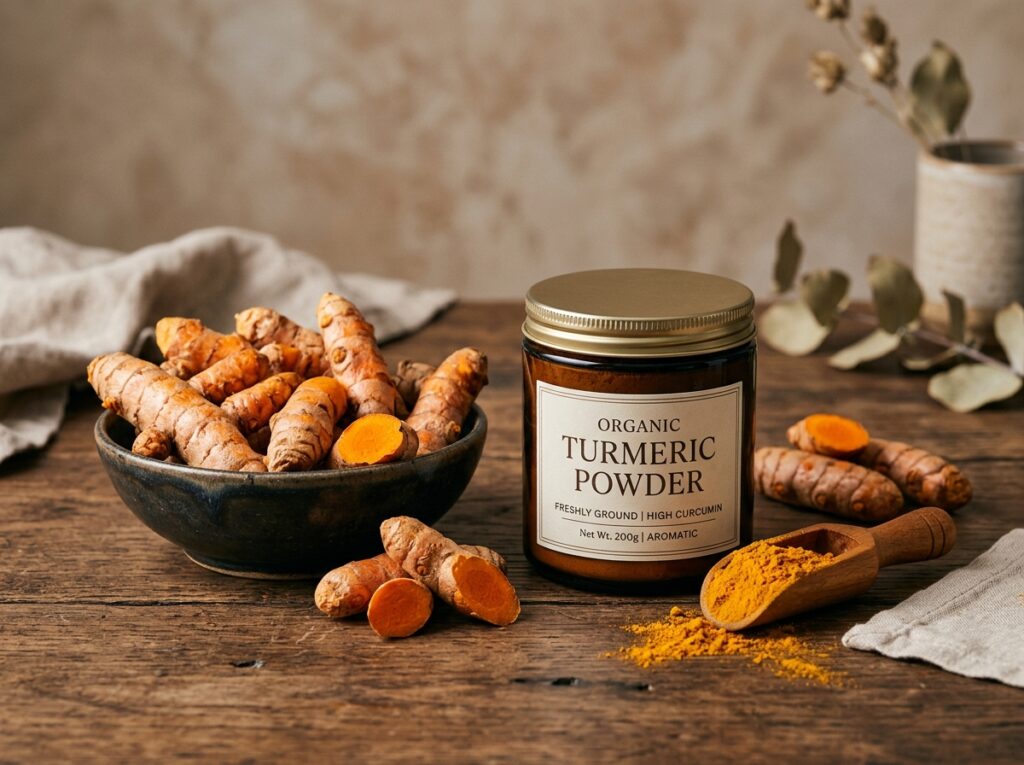
Walk into any Indian kitchen and you’ll find turmeric. It’s in the morning dal, the evening haldi doodh, the paste your grandmother swears by for a cut or a cold. But here’s an uncomfortable truth most of us have never stopped to ask about our daily haldi: how much of what’s in that jar is actually turmeric, should you choose organic turmeric and how much of it is doing anything at all?
The answer comes down to one compound: curcumin. And once you understand what it is, you’ll never buy turmeric powder the same way again.
What Curcumin Actually Is (And Why Organic Turmeric Matters)
Turmeric — the root, the powder, the golden-orange dust in your spice box — is just the delivery vehicle. Curcumin is the active ingredient inside it, the compound responsible for turmeric’s color, its aroma, and most of the health properties it’s famous for. Technically, curcumin belongs to a family of three related compounds called curcuminoids (curcumin I, II, and III), with curcumin I being the most abundant and most studied.
This distinction matters because not all turmeric powders contain the same amount of curcumin. Two jars can look identical on a shelf — same golden color, same “100% natural” label — and have wildly different curcumin levels. One could be genuinely potent. The other could be mostly filler with a dusting of color.
Why Curcumin Matters for Immunity
Turmeric’s reputation as an immunity booster isn’t just folk wisdom — there’s a real and growing body of research behind it, though it’s worth being precise about what the science actually says rather than reaching for vague marketing claims.
Researchers studying curcumin’s effect on the immune system have found that it doesn’t simply “boost” immunity in a generic sense. Instead, curcumin appears to help the immune system find better balance — calming down inflammatory responses when they’re overactive, rather than just stimulating immune activity across the board. Human studies have shown that curcumin supplementation can lower blood levels of certain inflammatory markers associated with an overactive immune response, which is a more nuanced (and more honest) way to describe its role than the blanket “immunity booster” label you’ll see on most packaging.
This is also why curcumin has become one of the most extensively studied natural compounds in modern nutritional science — with research spanning its anti-inflammatory, antioxidant, and cellular-protective properties. The takeaway for your kitchen: the more curcumin your turmeric actually contains, the more of this functional benefit you’re getting per teaspoon. A turmeric powder that’s heavy on starch and light on curcumin isn’t doing your body the same favours, no matter how vivid its colour looks.
So How Much Curcumin Should Turmeric Actually Have?
This is where most people are in for a surprise.
The Bureau of Indian Standards sets the bar for powdered turmeric at a minimum of just 3% curcumin. Most mass-market turmeric sold in Indian supermarkets hovers in the 2–5% range — technically compliant, but far from potent.
Then there’s Lakadong turmeric, grown in the Jaintia Hills of Meghalaya, which has earned a reputation as one of the highest-curcumin turmeric varieties in the world. Lab-tested Lakadong turmeric regularly comes in at 7–12% curcumin — up to three to four times more potent than standard varieties sold elsewhere. This isn’t marketing exaggeration; it’s a result of the region’s unique high-altitude climate, mineral-rich soil, heavy rainfall, and generations-old traditional, chemical-free cultivation methods that simply can’t be replicated elsewhere in India.
The practical implication: if you’re buying turmeric purely on the basis of “organic” or “100% natural” labeling without knowing the curcumin percentage, you genuinely don’t know what you’re getting. Organic certification tells you how it was grown — it says nothing about how potent it is.
A Quick Note on Absorption: Why Pairing Matters
One detail worth knowing if you actually want curcumin’s benefits to reach your bloodstream: curcumin on its own is poorly absorbed by the body. It’s fat-soluble, and its absorption is dramatically improved when paired with black pepper (specifically the compound piperine) and a source of fat — which is exactly why traditional Indian cooking almost always combines turmeric with oil or ghee, and why haldi doodh is traditionally made with warm milk rather than water. This isn’t a coincidence; it’s centuries of practical wisdom that modern nutrition science has only recently caught up to and confirmed.
How to Identify Pure Turmeric Powder (4 Simple Tests You Can Do at Home)
Now for the part that should genuinely concern every household: turmeric is one of the most commonly adulterated spices in India. In 2019, researchers at Stanford published a study confirming the presence of toxic lead chromate pigment in turmeric powder samples — a finding that should make anyone rethink buying loose or unbranded turmeric without question.
Here’s what turmeric is commonly adulterated with, and how to check for each one at home.
1. The Water Settle Test (for general purity — start here)
Drop a teaspoon of turmeric powder into a glass of water and leave it undisturbed for about 20 minutes — don’t stir.
- Pure turmeric sinks to the bottom, leaving the water only lightly tinted.
- Adulterated turmeric leaves a dark, uneven yellow stain that doesn’t settle properly, or shows streaks of colour bleeding through the water — a sign of added synthetic dye or lead chromate.
This is the easiest, safest test and a good first checkpoint for any turmeric you buy.
2. The Texture Test (for fillers like chalk or sawdust)
Take a small pinch of turmeric powder and rub it between your fingers.
- Pure turmeric feels smooth and leaves a natural yellow stain on your skin.
- Adulterated turmeric feels gritty, sandy, or unusually shiny — signs of chalk powder, brick dust, sawdust, or lead chromate being mixed in.
3. The Iodine Test (for starch fillers)
Spread a small amount of turmeric powder on a white plate or paper towel and add a single drop of iodine solution.
- If the powder turns blue-black, it contains added starch (commonly rice or wheat starch used to bulk up volume cheaply).
- Pure turmeric will show no such colour change.
4. The Hydrochloric Acid Test (for metanil yellow and chalk powder — use with caution)
This test is more diagnostic but requires handling dilute hydrochloric acid, so it’s best left to those comfortable doing so carefully, with gloves and ventilation, or simply skipped in favour of the first two tests if you’d rather avoid chemicals at home.
- Mix turmeric powder with water and a few drops of hydrochloric acid. If the solution turns pink, it indicates metanil yellow — a non-food-grade synthetic dye linked to liver and nervous system harm with long-term exposure.
- If the mixture instead fizzes or bubbles, it indicates chalk powder (calcium carbonate), used purely to add cheap bulk weight.
What Organic and FSSAI Labels Do (and Don’t) Guarantee
It’s worth being transparent about something most brands won’t tell you: an “organic” label confirms the turmeric was grown without synthetic pesticides or fertilizers — it does not automatically confirm curcumin content, and it doesn’t by itself rule out adulteration that may happen later in processing or packaging. Similarly, FSSAI registration is a baseline legal requirement for any business selling food in India, not a guarantee of high curcumin levels or zero adulteration.
The only way to really know what’s in your turmeric is third-party lab testing for curcumin percentage, combined with full transparency about sourcing — which region the turmeric is grown in, how it’s processed, and whether anything is added after harvest.
The Bottom Line
Pure turmeric should do three things: settle cleanly in water, feel smooth between your fingers, and carry a high enough curcumin percentage to actually deliver the benefits it’s known for. Anything less is, at best, a weaker version of what you think you’re buying — and at worst, a genuine health risk.
This is exactly why we test [Brand Name]’s organic turmeric for curcumin content and publish our lab results openly, rather than asking you to take “100% natural” on faith. When you’re sourcing something you put in your body every single day, you deserve to know exactly what’s in it.
[Shop our lab-tested organic turmeric powder →Services]
This article is for general informational purposes and is not a substitute for professional medical or food safety advice.
-
Organic Atta vs Non-Organic Atta: Why Your Roti Deserves Better
The Ultimate Guide to Organic Atta: Why It Outperforms Regular Flour Every Time Every Indian kitchen runs on atta. It’s in our morning parathas, our evening rotis, our festival pooris. But somewhere between the wheat field and your flour dabba, most commercial atta loses a lot more than just freshness. If you’ve been wondering whether…
-
Why Nutrient Density Is the New Gold Standard in Indian Kitchens — And Why Cold Pressed Oil Leads the Way
Unlock the Nutrient Power Hidden in Every Drop of Cold Pressed Oil For generations, our grandmothers didn’t count calories — they trusted their ghani. Long before “nutrient density” became a buzzword in wellness circles, Indian households understood a simple truth: how food is made matters as much as what it’s made of. Today, science is…
-
The Golden Spice: Curcumin in Organic Turmeric Why It Matters for your Immunity And Learn How to Tell If Your Haldi Is Even Real.
Walk into any Indian kitchen and you’ll find turmeric. It’s in the morning dal, the evening haldi doodh, the paste your grandmother swears by for a cut or a cold. But here’s an uncomfortable truth most of us have never stopped to ask about our daily haldi: how much of what’s in that jar is…